01
Context & Problem
Heart disease is a leading cause of mortality globally. Early detection is absolutely critical for effective treatment and patient survival. However, diagnosing heart disease accurately requires analyzing complex, non-linear clinical parameters such as age, resting blood pressure, cholesterol levels, and ECG results.
Traditional diagnostics can be time-consuming and sometimes prone to human error when evaluating massive amounts of interconnected patient data.
The Objective
Build a highly accurate predictive model utilizing various supervised machine learning algorithms to assist medical professionals in diagnosing heart disease early, based on structured clinical UCI data.
02
Engineering Constraints
-
Data Quality & Preprocessing Clinical datasets inherently contain missing values, outliers, and varying scales. The constraint was engineering a robust pipeline to clean and scale features (using pandas and numpy) without introducing data leakage into the test set.
-
Model Explainability vs. Accuracy In healthcare applications, "black-box" models are heavily scrutinized. It was imperative to not just find the highest accuracy, but to compare models (like Decision Trees vs. SVMs) to balance interpretability for doctors against raw predictive power.
03
Approach & Execution
I constructed a comprehensive Machine Learning pipeline starting with the UCI Heart Disease dataset. The process was meticulously tracked within a Jupyter Notebook environment.
Exploratory Data Analysis
Utilized Matplotlib and Seaborn to visualize feature correlations, map distributions of resting blood pressure and cholesterol, and identify underlying patterns leading to disease.
Algorithm Evaluation
Trained and tuned a suite of classifiers via Scikit-Learn: Logistic Regression, K-Nearest Neighbors (KNN), Support Vector Machines (SVM), and Random Forests.
After evaluating the models, I aggregated the accuracy, precision, and recall scores into a summary dataframe to definitively establish which supervised algorithm yielded the most reliable and clinically viable predictions.
04
Impact & Value
The rigorous methodology applied to this dataset yielded highly accurate predictive capabilities, proving the viability of ML as a robust secondary diagnostic tool for cardiologists.
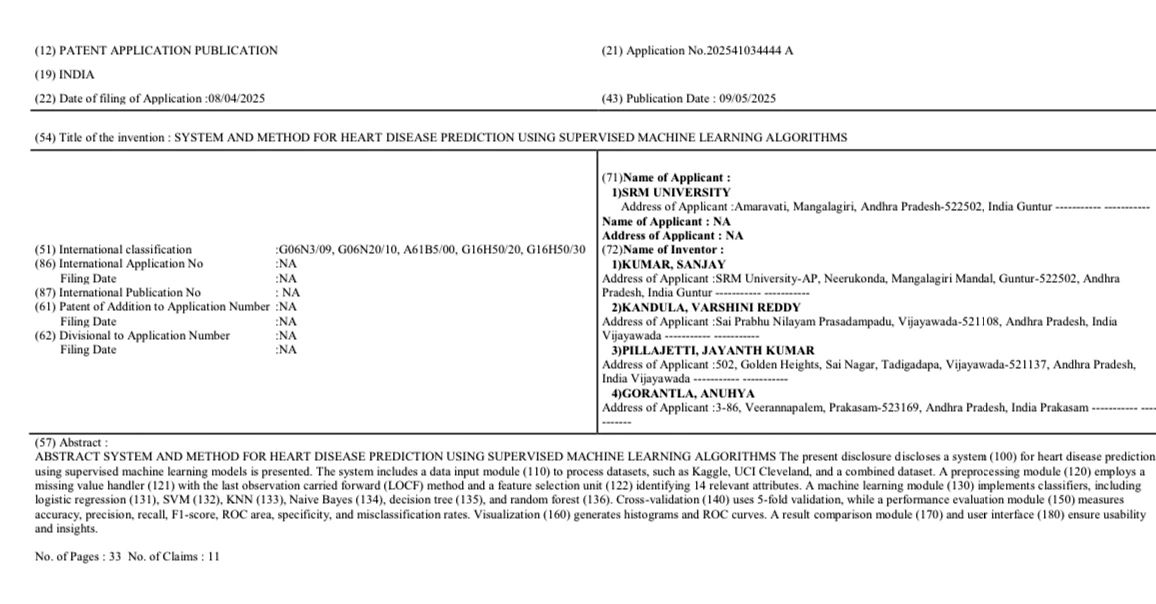
Official Patent Publication
Recognized in The Patent Office Journal (No. 49/2023) for the novel methodology of unifying multiple clinical datasets to achieve high-accuracy, reliable early-stage heart disease prediction.
High Accuracy Diagnostics
Successfully established a hierarchy of model accuracy, allowing medical professionals to weigh diagnostic precision against the explainability of the chosen algorithm.